A roof valley is the inside corner where two slopes of the roof meet, forming a V. If your house has more than a simple two-sided roof, it almost certainly has a few. Valleys look like nothing from the ground. They also happen to be one of the places a roof is most likely to leak.
Why valleys have it harder than the rest of the roof
Every slope sheds its rain downhill. Where two slopes meet, all the water from both sides funnels into the same narrow channel. So a valley carries far more water, and faster, than any single row of shingles out on the open roof.
That water also has to get past a seam. Shingles on a flat slope overlap in neat rows. In a valley, they have to be woven together, cut along a line, or laid against a strip of metal. Each of those methods works when it’s done well. Each has a weak point if it isn’t.
The common reasons a valley leaks
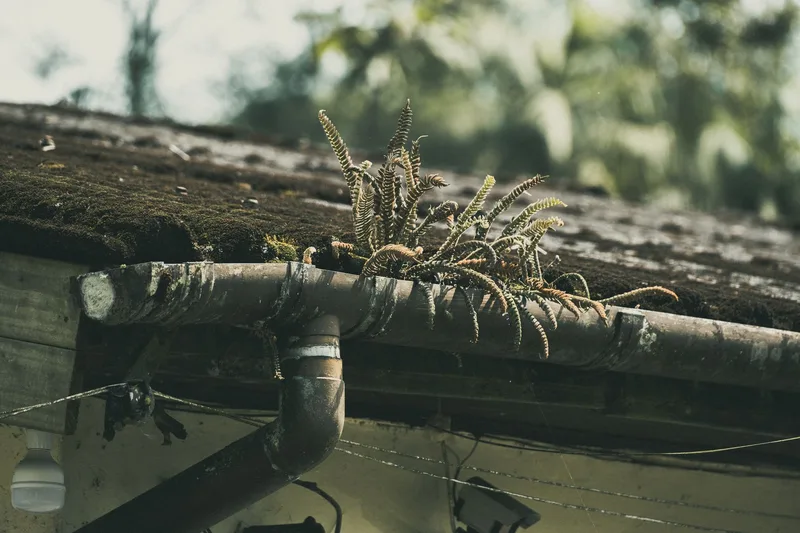
Debris piles up. This is the big one around Magnolia. Pine needles and oak leaves slide down the roof and collect in the valleys, where they mat into a damp layer that holds water against the shingles and slows the flow. Water that can’t run off finds another way, sometimes sideways and up under the shingle edges. Debris also keeps the valley wet for days after a rain, which wears shingles faster.
Shingles were cut too close or nailed too close. In a cut valley, the shingles from one side are trimmed in a line along the center. If they’re trimmed in the wrong place, or nails were driven too near the center of the valley, water running down the channel can reach those nail holes.
The metal is worn or loose. Some valleys are lined with metal flashing. Over many years that metal can rust, crack at a bend, or lift where it’s fastened. The shingle edges along it can also curl back and open a gap.
Wear from the water itself. Shingles in a valley see more water than shingles anywhere else, so they tend to lose their granules and wear out first. When a roof starts showing its age, the valleys often show it early. Our post on how long a roof lasts in the Texas heat covers more on that.
Heavy, sideways rain. A strong storm can drive water up the valley and under the edges of the shingles. That’s where the layer under the shingles, the underlayment, has to do its job. Valleys are one of the spots where a sealed membrane is often used under the shingles for exactly that reason.
What a valley leak looks like inside
Leaks at a valley rarely show up right under the valley. Water gets under the shingles, runs along the underlayment or the deck, and drips off wherever it can. Common signs:
A stain on a ceiling near an inside corner of the house, or along a wall below where two roof slopes meet.
A stain that shows up after long, heavy rains but not after a quick shower.
From the attic on a dry day: dark streaks or water stains on the wood along the line of the valley, or damp insulation below it.
What you can check from the ground
Stand back far enough to see the valleys clearly, and bring binoculars if you have them. Three things to spot:
Needles or leaves matted in the valley, especially down low where it empties into the gutter.
Shingle edges along the valley that are curled, lifted or missing.
The gutter where the valley empties, if it overflows in a hard rain. Valleys dump a lot of water into one spot, and an overflowing gutter there can push water behind the fascia board.
If you have trees close to the house, check the valleys more often, maybe after every heavy leaf drop. Clearing overhanging limbs helps too, which we covered in getting your roof ready for winter around Magnolia.
Clearing a valley safely
Debris in a valley is easy to see and tempting to go after. But valleys are steep, often slick with wet needles, and harder to stand in than the open roof. A long-handled tool from a ladder at the gutter line may reach the bottom of a valley. Anything higher up is a job for someone who can safely get up there. Don’t pressure-wash a valley; it strips the granules off shingles that are already working harder than the rest.
Questions about your roof?
Send us a request or call (832) 696-6347. We cover Magnolia, Montgomery, Tomball, The Woodlands and the towns around them.